
RouletteAid AI Review: Test Data, Features and Pricing
RouletteAid AI is a Windows desktop application that records live roulette spins, measures the hit rate of different bet types, suggests figures and progressions and includes a risk-control layer called Shield. It is sold as a prediction and decision-support tool, not as a guaranteed win system.
This review looks at the current V7.03 release, the published 5,000-prediction benchmark, the features that matter in practice, the pricing and the limitations you should know before buying. It is written by RouletteAid, so treat it as a transparent product review rather than an independent third-party test.
What RouletteAid does
RouletteAid is built around a simple workflow:
- Record spins from a live roulette table.
- Let the software build a history for each bet type: red/black, odd/even, high/low, dozens, columns, straight numbers, splits, streets, corners and lines.
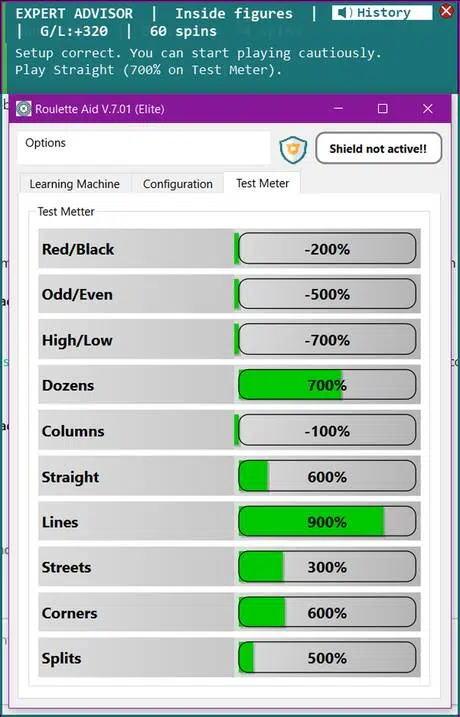
- Use the Test Meter to see which figures have the strongest measured hit rate.
- Follow a manual suggestion or let automatic mode manage the progression.
- Use the Shield, stop-loss and loss limits to pause or stop when conditions deteriorate.
- Save the learning for that table and recover it in a later session.
The software runs on Windows 10 and 11. It is designed primarily for live dealer roulette, where a real wheel and a real dealer produce the spin history. It is not a client-side bot that connects to a casino and places bets for you.
The published test: what 5,000 predictions show
RouletteAid publishes a benchmark based on 5,000 prediction samples. The headline results are:
| Model | Average prediction accuracy |
|---|---|
| Default | 25.4% |
| V7.0 | 48.6% |
| V5.05 + Shield | 53.9% |
| V7.0 + Shield + AI | 56.4% |
The same benchmark reports a +122% total lift for V7.0 + Shield + AI compared with the default model. The detailed chart shows different accuracy levels by bet type: outside bets generally have higher absolute accuracy, while inside bets such as straight numbers have lower absolute accuracy but much larger payouts when they hit. The test reports the largest relative improvement on straight bets.

What the test does not tell you. It does not show the full stake plan, the table limits, the variance you will experience or the exact definition of “accuracy” for each bet type. It is a product benchmark, not a peer-reviewed study. That does not make it useless: 5,000 samples is far more useful than a marketing claim based on 20 spins. But it should be read with the limitations in mind.
Feature review
Test Meter
The Test Meter is the most useful part of the software for a new user. It shows the measured hit rate for each figure and helps you compare outside bets with inside bets. Instead of guessing which figure is “hot”, you can see the sample and the current reading.
Manual and automatic modes
Manual mode lets you follow the software’s suggestions and keep control of each bet. Automatic mode manages the progression for you. Automatic does not mean risk-free: it means the software is applying its rules consistently. You still need a stop-loss and a bankroll limit.
Personalised progressions
RouletteAid builds a progression for each figure instead of applying one generic martingale to everything. That matters because a straight-number progression and a red/black progression have very different volatility. The software can adapt the staking plan to the selected figure and the current table conditions.
Shield
The Shield is a three-level risk system. When the measured hit rate for a figure falls below a configured threshold, the Shield pauses the progression, saves the state (“Photo Finish”), waits for two new results and resumes when the hit rate recovers. For red/black, the tutorial gives thresholds of 71%–66% (Level 1), 66%–56% (Level 2) and 56%–46% (Level 3), with the pause occurring below the Level 3 minimum. Other figures can use their own thresholds.
The Shield is not a guarantee. It is a structured way to avoid chasing a cold figure. It can help you preserve the bankroll, but it cannot turn a losing selection into a winning one.
Save and recover learning
You can save the history for a table and retrieve it later. If you play the same live wheel repeatedly, this can speed up the learning phase. If you switch tables, start a fresh history; a pattern from one wheel does not necessarily transfer to another.
Superlearning and history
The software keeps a session history and adapts its suggestions as new spins arrive. The tutorial recommends recording 30–50 spins before placing real bets, then checking the Test Meter every 20 spins. That is a sensible warm-up, not a permanent proof of a wheel’s behaviour.
Pricing
At the time of writing (9 November 2026), the shop lists four plans:
| Plan | Price | Notes |
|---|---|---|
| Elite Day | €29.00 | Short trial access |
| Elite Week | €29.00 (sale; regular €79.00) | One week of access |
| Elite Month | €99.00 (sale; regular €199.00) | One month of access |
| Elite Six | €499.00 | Six months of access |
A free demo is available, so you can inspect the interface before paying. Prices and offers change; check the RouletteAid shop for the current figures. The software is Windows-only, so a Mac or mobile user would need a Windows machine or a virtual machine.
What we like
- Transparent test data. The 5,000-prediction benchmark is published with a chart, not hidden behind vague claims.
- Useful Test Meter. It turns a vague “hot table” feeling into a visible hit-rate dashboard.
- Risk controls. The Shield, stop-loss and progression pause are practical protections that many competitors do not offer.
- Live-table focus. The software is honest about needing a real spin history.
- Free demo. You can test the workflow before committing to a plan.
Limitations and who should avoid it
- No guarantee. Roulette remains a game of chance; the house edge still exists.
- Developer-run benchmark. The test is not an independent audit. More third-party replication would strengthen the evidence.
- Windows only. There is no native Mac, iOS or Android app.
- Requires discipline. Automatic mode can still lose. Without a stop-loss and a bankroll limit, the software cannot protect you from yourself.
- Live tables only. RNG wheels do not provide the same physical context.
- Legal and venue rules vary. You are responsible for checking the law and the casino’s terms before using any prediction tool.
If you are looking for a guaranteed income, a “no-risk” system or a tool that places bets for you inside a casino client, this is not it. If you want a structured way to record spins, compare figures, manage progressions and apply risk controls, it is a credible option to test with the demo.
What about the 73% claim?
Some older pages on this site repeated a “73% win rate” claim. That figure is not consistent with the 5,000-prediction benchmark, which reports 56.4% average accuracy for V7.0 + Shield + AI. Different metrics and different samples can produce different numbers, but mixing them in public marketing creates confusion.
Our position is simple: use the published test figures, show the methodology and avoid promising a fixed win rate. The 56.4% average is the number we reference in this review, and it still comes with the caveat that historical tests do not guarantee future results.
How to use it responsibly
- Start with the free demo and the learning phase: record 30–50 spins before betting.
- Check the Test Meter every 20 spins and focus on figures with a meaningful sample.
- Use a stop-loss and a loss limit before you start. Decide in advance what you are willing to lose.
- Use the Shield when a progression is deteriorating; do not use it as an excuse to increase stakes.
- Keep a session log and review it. If the software is not helping after a fair test, stop.
Frequently asked questions
Is RouletteAid a scam?
It is a real Windows application with a published test benchmark, a demo and a working feature set. It is not a guaranteed win system, and the test is developer-run. The right way to judge it is to test the demo, read the methodology and use strict bankroll limits.
What is the real accuracy?
RouletteAid’s published 5,000-prediction benchmark reports 56.4% average accuracy for V7.0 + Shield + AI, with different results by bet type. Accuracy is not the same as profit.
Does the Shield guarantee a win?
No. It pauses progressions when the measured hit rate falls below a threshold and resumes after two new results. It is a risk-management feature, not a guarantee.
Can I use it on online roulette?
It is designed for live roulette tables with a real spin history. RNG wheels do not provide the same physical context. Check the casino’s terms before using any third-party tool.
Is it legal?
That depends on your jurisdiction and the casino’s rules. See our legality guide for a general overview. This is not legal advice.
Where can I see the full test chart?
The chart is on the RouletteAid shop page. The product page is RouletteAid AI².
Sources and further reading
- Roulette: rules, wheel types and probabilities — Wikipedia.
- BeGambleAware — support and advice for safer gambling.
- UK Gambling Commission — regulatory information.
Responsible gambling
RouletteAid is entertainment and decision-support software, not a guaranteed win system. Gambling involves risk and is 18+. Set limits, never chase losses and stop if gambling stops being fun. If you need support, contact BeGambleAware or Gambling Therapy.
Disclosure: This review is published by RouletteAid. The benchmark figures are from our published 5,000-prediction test and are not a promise of future results. We link to our own shop and product page.
More roulette guides: Browse all RouletteAid guides.