
How Roulette Prediction Software Works: Physics, AI and Limits
Roulette prediction software is one of the most misunderstood products in online gambling. Some sellers describe it as a machine that “beats the wheel”. Others dismiss every product as a scam. The truth is narrower: software can collect data, measure patterns, estimate probabilities and help you make more consistent decisions, but it cannot remove the house edge or guarantee a win.
This guide explains how prediction software actually works, which methods exist, what the published RouletteAid test data does and does not show, and how to evaluate any accuracy claim before you spend money.
What “prediction” means in roulette
Roulette is a game of chance. On a fair European wheel, a straight number has a 1 in 37 chance on every spin, regardless of what happened before. No algorithm can know the next number in advance unless it has a real, measurable physical or statistical edge.
Prediction software therefore works in one of two ways:
- Physical analysis. The software tries to estimate where the ball will land from observable data: wheel speed, ball speed, the point where the ball leaves the track, rotor position, dealer habits or a physical defect in the wheel. This is the classic “advantage play” approach and requires reliable measurements in real time.
- Statistical pattern analysis. The software records spin history and calculates how often each bet type (red/black, dozens, columns, straight numbers, splits, streets, corners, lines) has matched its prediction. It then selects the figures with the strongest recent hit rate and applies a bet progression.
RouletteAid belongs mainly to the second group. It is a Windows application that learns from the spins you record on a live table, ranks the figures through its Test Meter, suggests manual or automatic betting modes and uses the Shield algorithm to pause progressions when the measured hit rate falls below a configured threshold. It is a decision-support tool, not a crystal ball.
The data pipeline: from spins to a decision
A well-designed prediction tool follows a simple pipeline:
- Collect. The software records the results of recent spins, usually on a live dealer table.
- Learn. It builds a history for each bet type and calculates hit rates, streaks and volatility.
- Rank. It compares the figures and highlights the ones with the strongest measured performance. RouletteAid exposes this through the Test Meter.
- Decide. It proposes a figure and a progression, or waits when conditions are poor.
- Protect. Risk controls such as a stop-loss, a loss limit or the Shield can pause the progression and preserve the bankroll.
The weakest link is always the sample. A figure that hit 7 of the last 10 spins can look exceptional and still be normal noise. That is why serious tools show you the history, the sample size and a confidence meter instead of promising a fixed win rate.
Why live wheels and RNG wheels are different
Online roulette comes in two main forms:
- RNG roulette. A random number generator produces the result. There is no physical wheel to measure and no dealer pattern to read. Statistical patterns can still be tracked, but the underlying process is designed to be independent from spin to spin.
- Live dealer roulette. A real wheel and a real dealer produce the results, streamed to your screen. Physical and behavioural patterns are more plausible here, although modern wheels and procedures are designed to minimise them.
RouletteAid’s own tutorial recommends live roulette rather than slots or RNG-only tables. That is consistent with how the tool works: it needs a stream of real spin results to build a useful history.
What the published RouletteAid test shows
RouletteAid publishes a benchmark based on 5,000 prediction samples. The headline figures are:
| Model | Average prediction accuracy |
|---|---|
| Default model | 25.4% |
| V7.0 | 48.6% |
| V5.05 + Shield | 53.9% |
| V7.0 + Shield + AI | 56.4% |
The same benchmark reports a +122% total lift for V7.0 + Shield + AI compared with the default model. The detailed chart also shows that the largest relative improvement appears on straight bets, where the visual test reports an improvement of around +1,139% over the default model. Accuracy varies by bet type: outside bets such as red/black and odd/even are generally higher, while straight numbers are lower in absolute terms but can produce much larger payouts when they hit.
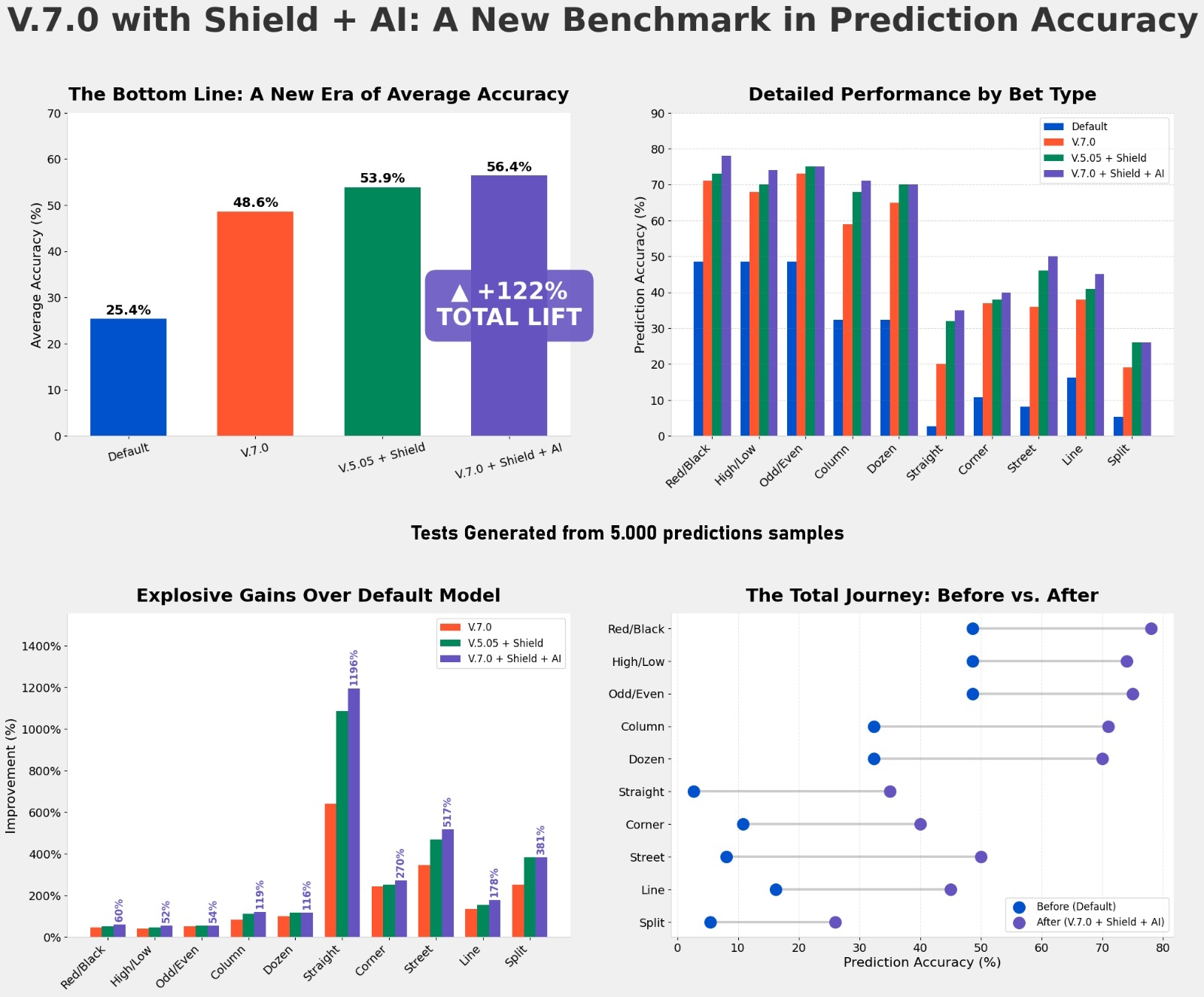
How to read those numbers honestly. Average accuracy is not the same as profit. A 56.4% hit rate on a bet that pays even money can be useful only if the stake sizing, table limits and losing streaks are managed. A lower hit rate on straight numbers can still be profitable because the payout is 35 to 1, but the variance is much higher. Any test should be read together with the bet type, the sample size, the stake plan and the fees.
How to evaluate any roulette prediction software
Before you buy any product, ask these questions:
- What exactly is being predicted? A number, a colour, a dozen, a column, a split or a general “market direction”?
- How large is the sample? A 50-spin test is marketing, not evidence. A 5,000-sample benchmark is more useful, but it still needs context.
- Is the test in-sample or out-of-sample? If the model was tuned on the same spins used to measure it, the result is optimistic.
- Does it work on RNG wheels or only live wheels? The answer changes what the software can realistically detect.
- What happens during a losing streak? Look for stop-loss, loss limits, pause logic and bankroll tools, not just a win-rate claim.
- Is the methodology public? A serious vendor should explain the test, the sample and the limits, not only show a single big number.
- What is the total cost? Licence, subscription, table minimums, time and the risk of losses all count.
No answer to those questions can turn roulette into a guaranteed income. The purpose of prediction software is to make your decisions more structured and to help you avoid the worst bets. It is not a substitute for bankroll discipline.
How RouletteAid implements the idea
RouletteAid AI² is the current version of the software. Its main components are:
- Test Meter. Shows the measured hit rate for each figure, so you can compare red/black, dozens, columns, straight numbers, splits, streets, corners and lines before betting.
- Manual and automatic modes. You can follow the suggestions yourself or let the software manage the progression.
- Personalised progressions. The software builds a staking plan for each figure instead of using one generic martingale.
- Shield. A three-level risk system that pauses a progression when the measured hit rate falls below a threshold, waits for two new results and resumes from the saved state.
- Save and recover learning. You can keep the history for a table and retrieve it in a later session, which is useful if you play the same live wheel repeatedly.
The software runs on Windows 10 and 11. The current shop lists Elite Day at €29, Elite Week at €29 (sale), Elite Month at €99 (sale) and Elite Six at €499. A free demo is available, so you can inspect the interface before paying.
See RouletteAid AI² features, test data and plans.
Frequently asked questions
Can roulette prediction software guarantee a win?
No. Roulette remains a game of chance. A tool can measure patterns and manage risk, but it cannot eliminate the house edge or guarantee future results.
What is a realistic accuracy figure?
It depends on the bet type and the sample. RouletteAid’s published 5,000-prediction test reports 56.4% average accuracy for V7.0 + Shield + AI, with lower absolute accuracy on straight numbers and higher accuracy on outside bets. Treat any single number with caution.
Does it work on online RNG roulette?
The software is designed primarily for live roulette, where real spins and physical wheels provide a meaningful history. RNG wheels are generated by software and are not measured in the same way.
Is the software legal?
That depends on your jurisdiction and the casino’s terms. Using analytics is not the same as manipulating a game, but advantage play can lead to account restrictions or bans. See our guide to roulette prediction legality.
Where can I see the full test chart?
The chart is published on the RouletteAid shop page and summarised in our RouletteAid AI review.
Sources and further reading
- Roulette: history, wheel types and betting rules — Wikipedia.
- BeGambleAware — independent advice and support for safer gambling.
- UK Gambling Commission — regulator information on gambling products and consumer protection.
Responsible gambling
RouletteAid is entertainment and decision-support software, not a guaranteed win system. Gambling involves risk and is 18+. Set a budget before you play, never chase losses and stop if gambling stops being fun. If you need support, contact BeGambleAware or Gambling Therapy.
Disclosure: This guide is published by RouletteAid and links to our software. The benchmark figures are from RouletteAid’s published 5,000-prediction test and are not a promise of future results.
More roulette guides: Browse all RouletteAid guides.