
Roulette Wheel Bias Analysis: What It Is and How It Is Measured
Roulette wheel bias is the idea that a physical wheel can favour some numbers because of tiny imperfections: a worn fret, a loose turret, a tilted rotor, a dealer’s release or a ball that behaves differently on one side of the track. If the bias is real and large enough, a player who measures it could gain an edge. If it is noise, the player is chasing ghosts.
This guide explains what wheel bias is, how analysts test for it, why most modern wheels are not exploitable and how a data-driven tool such as RouletteAid’s Test Meter fits into the picture.
What causes a biased wheel?
A roulette wheel is a machine with many moving parts. Small physical differences can make some sectors slightly more likely than others:
- Worn frets or separators. A damaged divider can change how the ball settles.
- Rotor tilt or imbalance. A wheel that is not perfectly level can create a subtle gravitational preference.
- Ball characteristics. Size, weight, material and track condition affect bounce and scatter.
- Dealer release. The speed and direction of the ball, and the point of release, can create short-term patterns.
- Maintenance and environment. Temperature, dust, static and table movement can all influence a physical wheel.
Older wheels in land-based casinos were sometimes biased enough to be exploited by professional players. Modern casino wheels are manufactured and maintained to much tighter tolerances, and casinos rotate wheels, balls and dealers to reduce predictable patterns. That does not make bias impossible, but it makes a large, stable, easily exploitable bias rare.
How do analysts measure wheel bias?
The basic method is straightforward: record many spins, count how often each number or sector appears, and compare the observed frequencies with the frequencies expected from a fair wheel. The hard part is deciding whether a difference is real or simply random variation.
1. Define the sample and the sectors
You can test individual numbers (37 pockets on a European wheel), physical sectors (for example, a group of adjacent numbers), colours, parity, dozens or columns. A sector test is often more powerful because it pools several pockets and produces a larger sample per group.
2. Calculate the expected frequency
On a fair European wheel, each number has a probability of 1/37. For a sector of k numbers, the expected probability is k/37. On an American wheel, the denominator is 38 because of the double zero.
3. Use a statistical test
The most common test is the chi-square goodness-of-fit test. It compares the observed counts with the expected counts and produces a p-value. A small p-value suggests that the observed pattern is unlikely under the fair-wheel assumption. Confidence intervals around each proportion are also useful, because they show the range of plausible values rather than a single estimate.
4. Demand a serious sample
This is where most claims fail. A wheel that produces 8 reds in 10 spins is not necessarily biased. Short samples are dominated by variance. To detect a small bias reliably, you may need thousands of spins, and the required sample grows quickly as the effect gets smaller. A test that looks at 20 numbers and picks the “best” one also suffers from the multiple-comparisons problem: with enough groups, one of them will look unusual by chance.
A useful rule of thumb: if someone claims a wheel is biased after a few hundred spins, ask for the confidence interval, the number of hypotheses tested and whether the result was replicated on a fresh sample.
5. Replicate out of sample
A real bias should persist when you collect new spins from the same wheel under the same conditions. If the effect disappears in a new sample, it was probably noise or a short-term dealer pattern. Replication is the difference between a data story and evidence.
Wheel bias versus prediction software
There are two different questions:
- Is the wheel physically biased? This requires measurement of the wheel, the ball and the environment, ideally with a controlled sample.
- Does a betting system have a measurable hit rate on this table right now? This is a statistical question about the sequence of results and the bet types you are using.
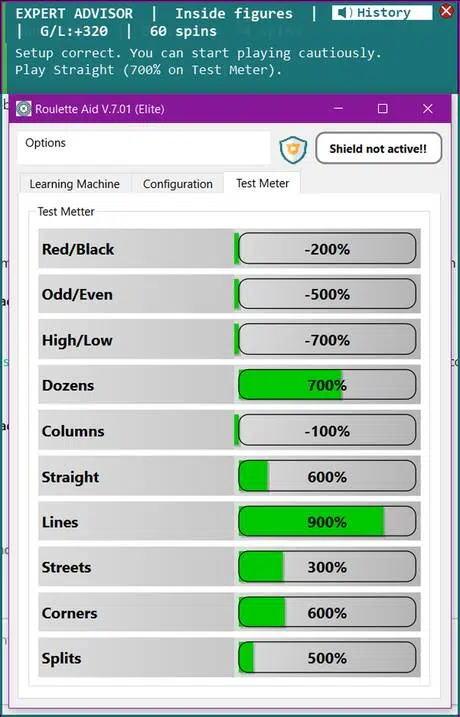
RouletteAid’s Test Meter addresses the second question. It records the spins you enter, calculates the hit rate for each figure and shows which figures have been performing better recently. It is a practical, real-time dashboard, not a laboratory measurement of a wheel defect. That distinction matters: a high Test Meter reading can reflect a genuine pattern, a short-term streak or simple randomness. The tool helps you compare figures and make a structured decision; it does not prove that the wheel is physically biased.
What the Test Meter can and cannot tell you
It can tell you:
- Which figures have matched the software’s predictions most often in the recorded sample.
- How the hit rate changes as new spins are added.
- When a figure is cooling down or heating up relative to its own history.
- When to compare inside bets (straight, split, street, corner, line) with outside bets (red/black, odd/even, high/low, dozens, columns).
It cannot tell you:
- That the next spin is mathematically determined.
- That a short hot streak will continue.
- That a wheel is physically defective without a proper physical measurement.
- That a bet is risk-free. Every bet still has a house edge.
The best use of the Test Meter is as a filter: it helps you avoid betting on figures that are clearly underperforming and focus on the ones with a stronger recent sample. It should be combined with stop-loss rules, a bankroll plan and the Shield, not used as a substitute for them.
Sample size in practice
RouletteAid’s tutorial recommends recording 30 to 50 spins before placing real bets, and then checking the Test Meter every 20 spins. That is a sensible learning phase for a live session, but it is not enough to prove a permanent bias. Treat the first 30–50 spins as a warm-up: enough to populate the interface and spot obvious patterns, not enough to declare that a wheel is beatable forever.
If you want to evaluate a wheel seriously, keep a longer log across multiple sessions, note the dealer, the ball and the table conditions, and look for consistency. If the pattern only appears in one short session, the most likely explanation is variance.
Practical checklist for evaluating a bias claim
- How many spins were recorded? Is the sample large enough for the size of the claimed effect?
- Were all numbers or sectors tested, or only the best-performing ones?
- Was the result replicated on a new sample from the same wheel?
- Were the wheel, ball and dealer conditions stable?
- Is the claimed edge larger than the house edge and the table limits?
- Does the vendor show the raw data and the methodology, or only a chart?
Frequently asked questions
Can a roulette wheel really be biased?
Yes, physical imperfections can create a small bias, especially on older or poorly maintained wheels. Modern casino wheels are designed and maintained to reduce this risk, so large exploitable biases are rare.
How many spins do I need to detect a bias?
It depends on the size of the effect. Small biases can require thousands of spins; obvious mechanical defects can show up sooner. Short samples are dominated by random variation, so replication is essential.
Does RouletteAid measure physical wheel bias?
RouletteAid’s Test Meter measures the hit rate of its predictions across bet types on the spins you record. It is a statistical dashboard for live play, not a laboratory measurement of a wheel defect.
Is wheel bias analysis legal?
Observing a wheel and recording results is generally not illegal, but using devices or methods that violate casino rules can lead to bans or legal consequences. See our legality guide.
Can the Test Meter guarantee a win?
No. It helps you compare figures and manage decisions, but roulette remains a game of chance and the house edge still applies.
Sources and further reading
- Roulette: wheel types and probabilities — Wikipedia.
- BeGambleAware — support and advice for safer gambling.
- UK Gambling Commission — regulatory information.
Responsible gambling
RouletteAid is entertainment and decision-support software, not a guaranteed win system. Gambling involves risk and is 18+. Set limits, never chase losses and stop if gambling stops being fun. If you need support, contact BeGambleAware or Gambling Therapy.
Disclosure: This guide is published by RouletteAid and links to our software. Test figures are from RouletteAid’s published benchmark and are not a promise of future results.
More roulette guides: Browse all RouletteAid guides.